
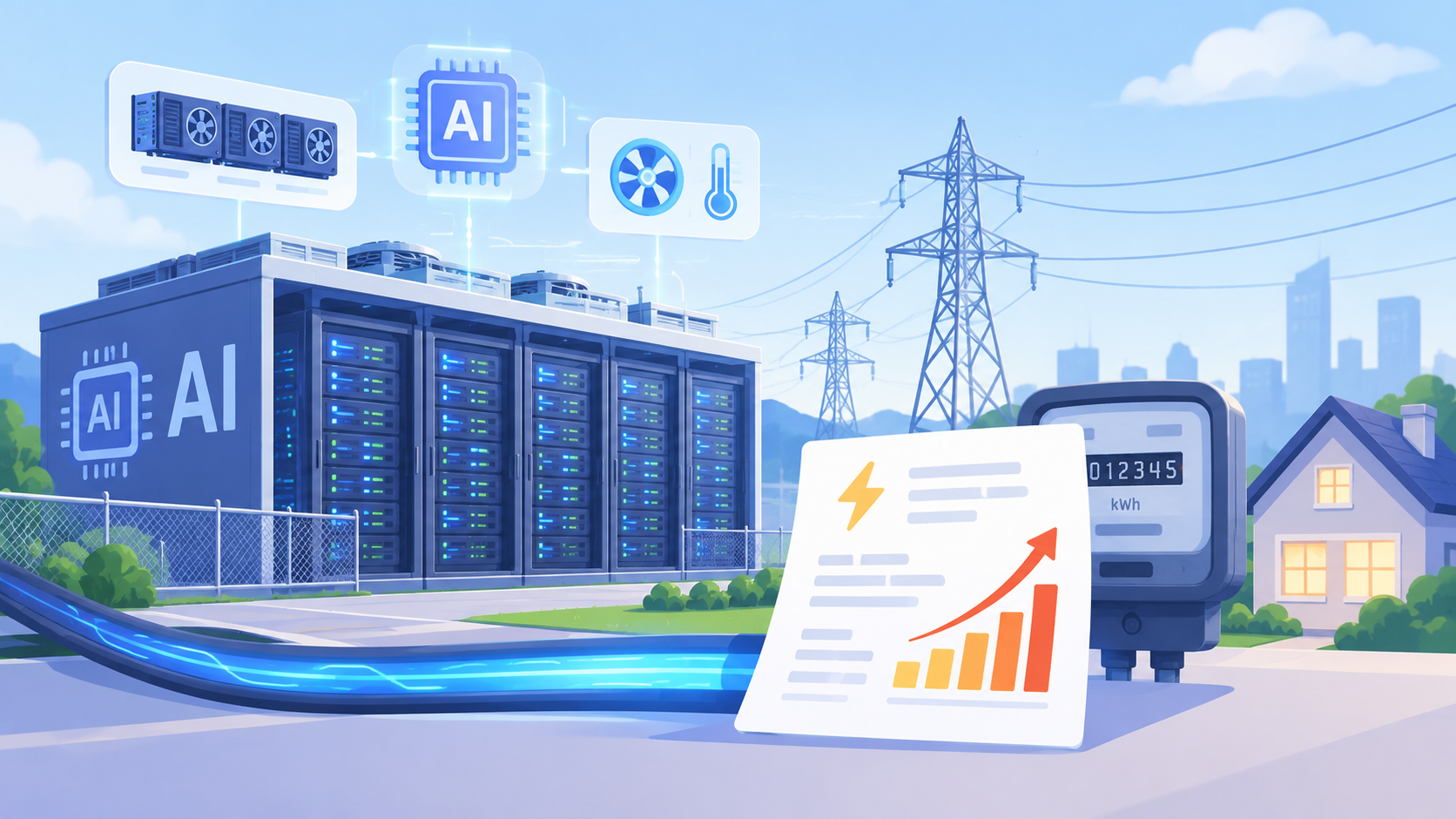
Data center electricity is usually invisible, which is why it took two reports in October 2026 to put it in front of ordinary households. Ars Technica reported that Amazon's $1 billion program meant to improve relations with data center communities drew more criticism instead, and Newtalk reported that Taiwan's Taipower is studying a differentiated electricity rate for large technology users, with a possible increase of more than 25% per kilowatt-hour. Different countries, same question: who pays for the power that AI needs?
That question reaches ordinary households through the grid, not through a cable running to your house. Understanding the path is the difference between a scary headline and a bill you can actually reason about.
01The two stories behind the backlash
The first story is about a company trying to smooth over local opposition. Amazon set aside $1 billion for a program aimed at improving its relationship with the communities around its data centers. According to the report, the effort drew more criticism rather than less.
The second story is about pricing. Taiwan's Taipower is reported to be considering a separate, higher rate for large technology customers, with an increase that could exceed 25% per kilowatt-hour. That would be a direct attempt to make the largest users carry more of the cost they create.
Read together, the two stories describe the same turning point. Data centers have grown from a niche industrial customer into a load that can shape a regional grid, and both companies and regulators are being asked to account for that.
02How much power a data center actually draws
A data center is not a big household appliance. Households are measured in watts and kilowatts; a large campus is measured in megawatts and is planned like an industrial site.
| Scale | Unit you see | Why it matters |
|---|---|---|
| Phone charger | watts (W) | Small, but often plugged in all day |
| Home appliance | watts to kilowatts | What a plug-in meter shows while it runs |
| Whole home | kilowatt-hours (kWh) | The unit your bill actually charges for |
| Data center campus | megawatts (MW) | A load a utility must plan generation and lines around |
The important difference is not just size. It is shape. A home draws power in bursts: a kettle for a few minutes, an oven for an hour, a charger overnight. A data center draws a large, steady load around the clock, and AI racks pack more power into the same floor space than traditional servers did.
That combination changes the planning problem. A utility cannot size the wires and the backup generation for the average, because the peak is what breaks the system. It has to build for the moment the campus is at full load, and someone has to pay for that capacity.
The IEA's Energy and AI analysis treats this growth in data centre demand as a grid-planning question, which is how regulators are beginning to handle it.
The label on a device is a ceiling, not an average
When a charger or an appliance says 60 W, that is the maximum it should draw, not what it uses every hour. Real consumption depends on how hard the device works and how long it runs, which is why your bill is measured in kilowatt-hours rather than watts.
03Why household bills move even when the rate doesn't
Your per-kWh rate can stay the same and your bill can still rise, because the costs around that rate change. There are a few channels.
The first is infrastructure. New transmission lines, substations and transformers are expensive, and regulators usually let utilities spread those costs across all customers. Even when a data center signs a special contract, the surrounding grid work is often socialized.
The second is supply and demand. When a region adds a large new load faster than it adds generation, wholesale prices rise, and regulated retail rates tend to follow with a delay.
The third is who gets the discount. If large users negotiate lower effective rates, the fixed costs of the grid do not disappear; they are recovered from the remaining customers. That is exactly the problem the Taipower proposal is trying to address in the other direction.
None of this means a single data center is the only reason a bill changed. It means the connection is real, and it runs through the shared grid rather than your own meter.
04Amazon's $1 billion plan and why it drew more criticism
Amazon committed $1 billion to a community program around its data centers. Announcing money for a community is a common response to local opposition, and it often fails for a predictable reason. A payment does not reduce the load a facility puts on the local grid, the water it uses, the land it occupies or the noise it makes. Residents who are objecting to those things do not experience the payment as a solution.
According to the Ars Technica report, the $1 billion program drew more backlash rather than calming it. That is the pattern worth remembering: goodwill spending answers the question "what do we get?" but not always the question "what changes?" When the answer to the second question is "nothing," communities tend to keep pushing.
05Taiwan's plan to charge the biggest users more
The Taipower proposal attacks the problem from the cost side. A differentiated rate creates a separate tariff class for large technology customers, so the biggest consumers pay more per kilowatt-hour. According to reports, the increase for those users could be more than 25%.
Governments and utilities have several tools for this, and they are not mutually exclusive.
| Approach | How it works | Who carries the cost |
|---|---|---|
| Higher rate for large users | A separate tariff class pays more per kWh | The data center operator |
| Co-funding grid upgrades | The company pays for new lines and substations | Operator, sometimes shared |
| Standard ratepayer recovery | Upgrade costs spread across all customers | Households and small businesses |
| Siting and resource rules | Limits on location, water use or backup generators | Operator and host community |
The choice is really about principle: should the cost of serving a huge load be paid by the customer that creates it, or shared across everyone who uses the same network? Most countries are still answering that question case by case, which is why the same debate keeps appearing in different places.
06Estimate your own electricity use in five minutes
You cannot control the grid, but you can understand your own bill. The formula is simple: kilowatt-hours equal watts multiplied by hours, divided by 1000. For a monthly estimate, multiply by the number of days.
Start by listing the devices you care about with the watts from their labels and an honest guess at daily hours.
{
  "currency": "USD",
  "ratePerKwh": 0.30,
  "devices": [
    { "name": "Device A", "watts": 60, "hoursPerDay": 8 },
    { "name": "Device B", "watts": 120, "hoursPerDay": 3 }
  ]
}
Then apply the formula to each entry. This snippet is illustrative — swap in your own numbers and rate.
const ratePerKwh = 0.30;
const devices = [
  { name: "Device A", watts: 60, hoursPerDay: 8 },
  { name: "Device B", watts: 120, hoursPerDay: 3 },
];

let total = 0;
for (const device of devices) {
  const kwh = (device.watts * device.hoursPerDay * 30) / 1000;
  total += kwh;
  console.log(`${device.name}: ${kwh.toFixed(2)} kWh/month`);
}
console.log(`Total: ${total.toFixed(2)} kWh/month`);
console.log(`Cost: ${(total * ratePerKwh).toFixed(2)}`);
The output is a monthly total you can compare with your actual bill:
Device A: 14.40 kWh/month
Device B: 10.80 kWh/month
Total: 25.20 kWh/month
Cost: 7.56
If the estimate is far below your real bill, the difference is usually the big continuous loads you forgot: heating, cooling, refrigeration or something that runs all night. If it is far above, check whether you used the maximum wattage where the device actually idles most of the day.
Unit confusion is the other common trap. Labels quote watts, utilities bill kilowatt-hours, and some spec sheets use BTU per hour. Converting everything into one unit first keeps the comparison honest, and a power converter does that in one step.
07Where a household can actually cut usage
Household conservation will not offset a data center campus, so treat this as managing your own bill rather than fixing the grid.
- Find the continuous loads first. Anything that runs for many hours matters more than a high-wattage device used for minutes.
- Measure instead of guessing. A plug-in power meter turns "probably the fridge" into a number you can act on.
- Shift rather than cut, if your rate allows. Time-of-use plans reward moving heavy loads to cheaper hours.
- Deal with standby power. Devices that stay warm in standby still consume, and it adds up across a whole home.
- Watch the biggest category first. In most homes that is heating and cooling, not chargers or lights.
Do not confuse peak watts with running watts
A motor or compressor can draw far more at startup than while running. When you size a backup battery or estimate a circuit load, use the startup figure; when you estimate energy over time, use the running figure.
The honest summary is that AI data centers are large enough to affect how power is priced and planned, and the cost question is now political as well as technical. For a household, the practical move is smaller: understand your own kilowatt-hours, and let the grid debate be a debate rather than a reason to panic about next month's bill.
08Sources
- Amazon's $1B plan to combat data center backlash draws more backlash — https://arstechnica.com/tech-policy/2026/10/amazons-1b-plan-to-combat-data-center-backlash-draws-more-backlash/ (accessed 2026-10-09)
- Amazon pledges $1B over 5 years for data center communities amid backlash — https://apnews.com/article/amazon-data-centers-1-billion-investment-91b65ba1729540c1c0d92e35deef35d8 (accessed 2026-10-09)
- 台電研議科技大戶差別電價 每度恐漲25%以上 — https://newtalk.tw/news/view/2026-10-04/1063459 (accessed 2026-10-09)
- Energy and AI — https://www.iea.org/reports/energy-and-ai (accessed 2026-10-09)
- Electricity explained: Measuring electricity — https://www.eia.gov/energyexplained/electricity/measuring-electricity.php (accessed 2026-10-09)
Frequently asked questions
Will a nearby data center raise my household electricity bill?
It can, through the grid rather than through your meter. If the utility spreads the cost of new lines, substations or generation across all customers, households pay part of it even when the data center has its own contract.
Does a data center use more electricity than a factory?
Large facilities are planned as industrial loads, and AI racks are denser and run continuously. The point is not the exact ranking; it is that a single campus can shape how a utility plans supply for a whole region.
What is a differentiated electricity rate?
It is a separate tariff class for a type of customer, in this case large technology users. Taiwan's Taipower is reported to be studying one, with a possible increase of more than 25% per kilowatt-hour for those users.
Why did Amazon's $1 billion community plan draw more criticism?
According to Ars Technica, the program intended to improve relations with data center communities instead attracted more backlash. Payments for goodwill do not by themselves change the load a facility puts on local power and water, which is often what residents are objecting to.
How do I calculate what an appliance costs to run?
Multiply its watts by the hours it runs, divide by 1000 to get kilowatt-hours, then multiply by your rate. A 60 W device running 8 hours a day uses about 14.4 kWh a month at 30 days.
Should I worry about my own usage when data centers are the big consumers?
Household usage is small next to an industrial campus, so your bill is not what drives the issue. Measuring your own use is still useful: it tells you which appliances matter and whether a time-of-use rate would save you money.
Related articles
- Audit and control Full Disk Access on macOS
The same instinct that audits app permissions applies to auditing what runs in your home.
- Choose and self-host a coding agent harness
Running your own agent is another place where compute demand meets your budget.
Related tools
- Power Unit Converter
Turn watts into kilowatts, and kilowatts into BTU per hour.
- Unit Converter
Convert the other units you meet on an energy bill or a spec sheet.
- JSON Multi-tool Suite
Clean up the appliance readings you keep as JSON before you total them.