
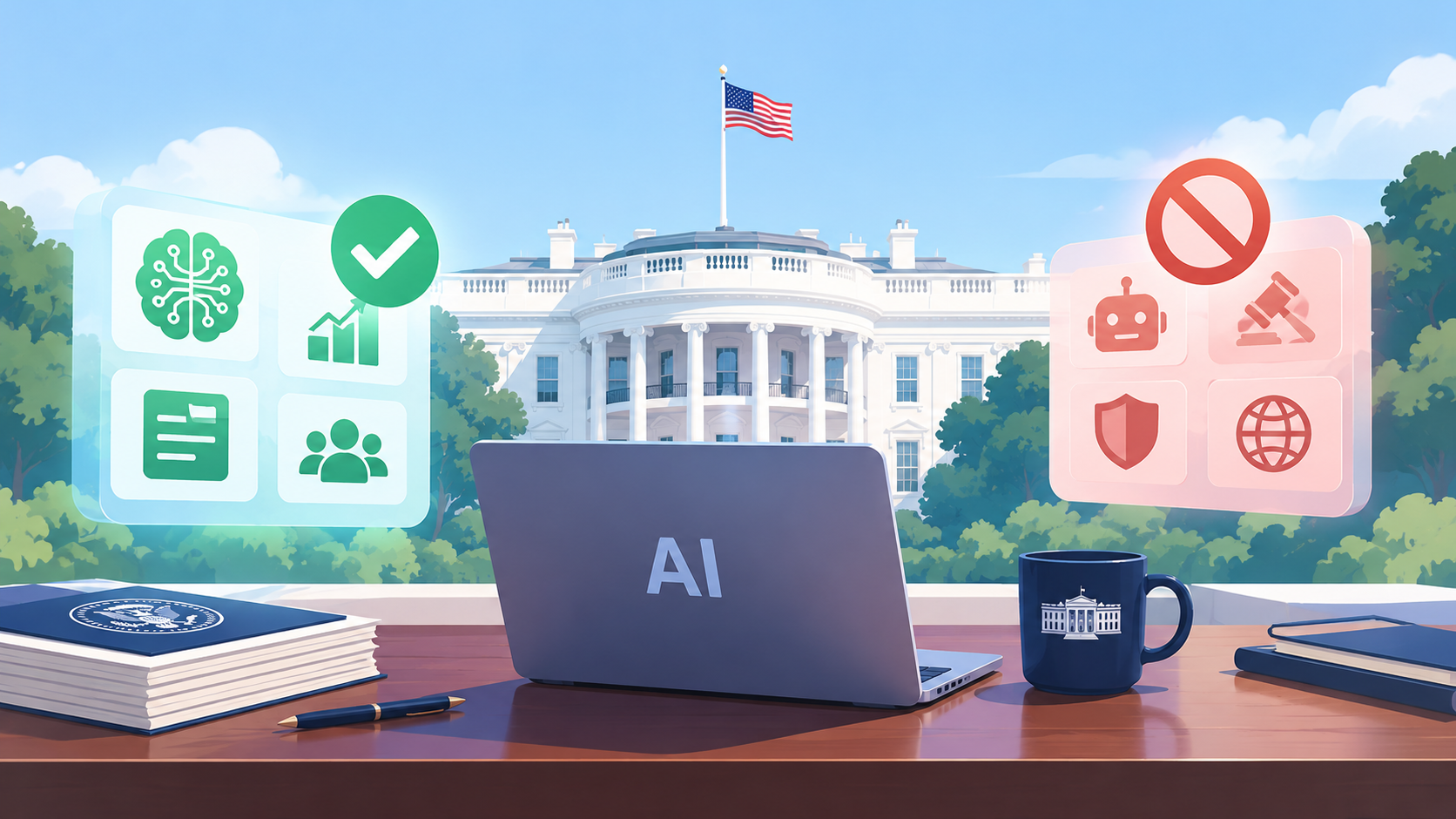
AI regulation news usually arrives as either a triumph or a disaster, depending on who is telling the story. The reports about the White House AI task force are more interesting than that framing. According to reports from outlets including The Wall Street Journal, Bloomberg and The Telegraph, the US executive branch has set up a group to review how artificial intelligence is being used across the government and the wider market, and it has been given a rough 120-day window to report back. That is a deliberately modest brief, and understanding why it is modest is the key to reading the coverage without overreacting.
This article walks through what the task force is, how it is organized, what it can realistically do, and what it means for an ordinary person who uses AI tools every day.
01What the White House AI task force actually is
A task force, in the language of government, is a working group with a deadline. It is not a legislature, a court or a regulator with new powers. Its job is to gather information, compare how different parts of an organization are handling a problem, and produce a written report that recommends what to do next.
According to reports, the group has been asked to look at both the risks and the opportunities of AI. That is a noticeably broad mandate. Rather than drafting a single rule about, say, model training or facial recognition, it appears to be mapping the terrain: where AI is already in use, where it is unsupervised, where existing rules still apply, and where there is a genuine gap.
That mapping work sounds bureaucratic, and some of it is. But it is also how governments discover that the rules they already have cover a lot more than people assume. Data protection law, consumer protection law, procurement rules and anti-discrimination law did not disappear the day a chatbot showed up. A review body can point at what already exists before it asks for anything new.
A report is not a rule
The most common mistake in coverage of any task force is treating its recommendations as if they were already law. A recommendation has to survive the normal process — Congress, agencies, courts, public comment — before it changes what a product may do.
02Who is involved, and why an AI czar chairs it
Reports name Jay Clayton as the AI czar leading the effort. The word "czar" is a press shorthand, not an official rank. In practice it usually means a senior figure is expected to coordinate across departments that do not report to each other: the agencies that buy technology, the ones that regulate industries, and the ones that handle national security.
Coordination is the hard part. A single agency can write rules about the things it already oversees. What it cannot easily do is make sure that five agencies are not pursuing contradictory standards for the same technology. A chair with a deadline is one way to force those conversations to happen on a schedule rather than eventually.
According to the same reports, the group includes people drawn from different parts of government rather than a single department. That composition tells you something about intent. A purely technical panel would focus on model behavior; a purely legal panel would focus on statutes. A mixed panel is being asked to connect the two.
03What it can do, and what it cannot
The clearest way to follow this story is to keep two columns in your head: what a review body can realistically deliver, and what requires someone else to act.
| Action | Can the task force do it on its own? | Who actually can |
|---|---|---|
| Publish a risk assessment | Yes, that is the core deliverable | The group itself |
| Recommend new rules | Yes, as recommendations | Congress or agencies |
| Enforce existing law | No, unless charged explicitly | Existing regulators and courts |
| Approve or ban a product | No | Agencies acting under existing authority |
| Set procurement conditions | Indirectly, through advice | The agencies that award contracts |
| Change your account settings | No | The companies you use |
The table matters because a lot of commentary skips the middle columns. A headline that says an AI task force is "cracking down" invites you to imagine enforcement. Reports describing a review with a 120-day deadline describe something narrower: a group writing down what it finds.
That does not make the work pointless. Governments have repeatedly shaped technology markets through procurement — the terms they attach to what they buy — long before any law passed. If an AI task force convinces agencies to require certain documentation, logging or testing from vendors, that can ripple outward even without a statute.
04Why the 120-day deadline is the real story
Deadlines are how a review is prevented from becoming a permanent discussion. A 120-day report forces the group to decide what it thinks before the political window closes.
It also creates a document that everyone else can react to. Once findings are written down, vendors can respond, civil society groups can point at gaps, and legislators can decide whether to pick up an issue. The report itself may not change a single product, but it changes what is arguable, and that is usually the first step in regulation.
Watch for the gap between "reviewed" and "resolved"
A report that lists a risk has not fixed the risk. When the deadline passes, the honest question is which items moved into an actual rulemaking or procurement change, and which stayed on a slide.
05The "Super Intelligence Force" nickname and the deregulation argument
Taiwanese and other regional coverage has picked up the group under a dramatic nickname — sometimes translated as the "Super Intelligence Force" — and framed it against a backdrop of deregulation. The claim in that coverage is not that the group is weak, but that a light-touch approach in Washington risks leaving a supervisory vacuum, which could allow AI-related harms to grow before anyone builds a response.
Both halves of that argument are worth taking seriously, and neither is settled.
- The case for a light touch: rules written in a hurry age badly, and a review that maps real risks is more useful than a ban aimed at last year's technology.
- The case for urgency: risks that are already observable — fraud, impersonation, insecure agents, opaque data handling — do not wait for a report to arrive.
Reports say the group is expected to address both risks and opportunities. If it delivers on that, the output should be a map rather than a verdict. Readers should be suspicious of any summary that reduces it to a single stance.
06A practical audit you can run yourself
Politics aside, the task force debate is really about visibility: does anyone actually know what AI is doing inside a system? That question applies to your own tools too, and you can answer part of it today without waiting for anyone in Washington.
One habit that helps is writing your own AI usage policy as data instead of prose. A short JSON document is easier to review, diff and enforce, and you can validate it automatically.
{
  "policyVersion": "1.0",
  "tools": [
    { "name": "assistant", "canReadData": true, "canWriteData": false, "requiresApproval": ["send", "delete", "pay"] }
  ],
  "credentials": { "maxLifetimeMinutes": 60, "scope": "least-privilege" },
  "logging": { "recordToolCalls": true, "retentionDays": 90 }
}
You can turn that document into a schema with a JSON schema generator and then check any new tool description against it before you wire it up. The point is not the specific fields. The point is that "what is the AI allowed to do" becomes a file with an answer, not a vibe.
The same discipline explains why the government review exists. Oversight is expensive when nobody wrote down what a system was supposed to do in the first place. A 120-day report is a country-sized version of that exercise.
07What ordinary users should take away
The White House AI task force is not going to change your chatbot tomorrow, and reports about it are not evidence that regulation has arrived. What they are evidence of is a shift in how seriously the topic is being tracked: instead of arguing only about principles, the people involved are being asked to produce findings on a clock.
For now, three things are worth holding onto. First, a review body recommends; it does not enforce. Second, the most durable effects of a review often show up in procurement and documentation requirements rather than in headline-grabbing bans. Third, the questions a government asks about AI — what can it reach, who approved it, what did it do — are the same questions you should ask about the AI you already run.
That last point is the one you can act on. You do not need a task force to know which accounts your assistant can touch, or how long its tokens live.
Frequently asked questions
What is the White House AI task force, in plain terms?
According to reports, it is a group inside the US executive branch asked to review how artificial intelligence is being used and where the risks are, then hand back recommendations within 120 days. It is a review body, not a legislature.
Who leads it?
Reports name Jay Clayton as the AI czar chairing the task force. That title describes a coordinating role across agencies, not authority to write binding rules on its own.
Does the task force ban or approve AI products?
No. A task force of this kind produces findings and recommendations. Actual restrictions would have to come from Congress, from existing agencies acting under existing law, or from courts.
Why is it sometimes called the Super Intelligence Force?
That is a nickname that appeared in coverage and commentary. It is a label for the group, not a technical description of what it does or a claim that it handles a new kind of machine.
What is the 120-day deadline for?
According to reports, the group is expected to report on AI risks and opportunities within roughly 120 days. The value of the deadline is that it forces a written record instead of an open-ended discussion.
Do I need to change anything about how I use AI today?
Not because of this task force. Nothing it does changes your account settings or the tools you can access. The practical advice stays the same: understand what each tool can reach and keep your data in mind.
How should I read headlines about it?
Carefully. Distinguish what the group is formally asked to do from what commentators hope or fear it will do. Reports based on unnamed officials are descriptions of a plan, not a record of what has been enforced.
Related articles
- Rogue AI agents: what they are and how to stay safe
Why runaway automation is usually a permissions problem, not a machine waking up.
- Prompt injection: how text hijacks your AI tools
The risk class every AI oversight debate eventually runs into.
Related tools
- JSON Schema Generator
Describe your AI policy once and get a schema you can validate against.
- JSON Multi-tool Suite
Format and validate the configs your AI tools read.
- Base64 Encoder / Decoder
Decode opaque values you find in logs and policy exports.