

For everyday writing, start with Claude Sonnet 5.5. For difficult coding work, consider Claude Opus 5.5. For images and video, use the category shortlists below rather than paying for a general chat winner. The best AI models in 2026 depend on the job, the product you can access, and the cost of getting a usable result.
This guide is for people choosing a writing assistant, coding model or creative workflow. Our recommendations combine a saved Arena ranking snapshot with official model and pricing pages checked on October 14, 2026. They are editorial picks, not the results of our own hands-on model test.
01Best AI models in 2026: quick picks by task
| Task | Starting choice | Why choose it | When to choose something else |
|---|---|---|---|
| Emails, drafts and everyday work | Claude Sonnet 5.5 | A practical starting point with an accessible Claude entry route and lower API rates than Opus. | Use Opus for more complex work; consider Gemini Argon only after confirming access. |
| Complex coding and repository changes | Claude Opus 5.5 | Leads our saved agentic coding list; the vendor positions it for work requiring sustained judgment. | Use Sonnet for well-scoped bug fixes or compare GPT Sol on the same repository task. |
| A website or interface | Claude Sonnet 5.5 or Opus 5.5 | Both have variants near the top of our saved WebDev list. | GPT Astra is a leading alternative in that task category. |
| Text-to-image generation | GPT image 2.5 Sunburst shortlist | Highest preference score in our saved image list. | Compare Flare; this list does not rank photo editing workflows. |
| Text-to-video generation | Compare the two leading Gemini Omni variants | Their overlapping score intervals make a single winner difficult to justify. | Choose by access, usable output and required input mode. |
The reasons and limits behind these choices follow. The ranking names include effort or variant labels, such as Max and high. An app subscription is not a guarantee of access to that exact evaluated configuration.
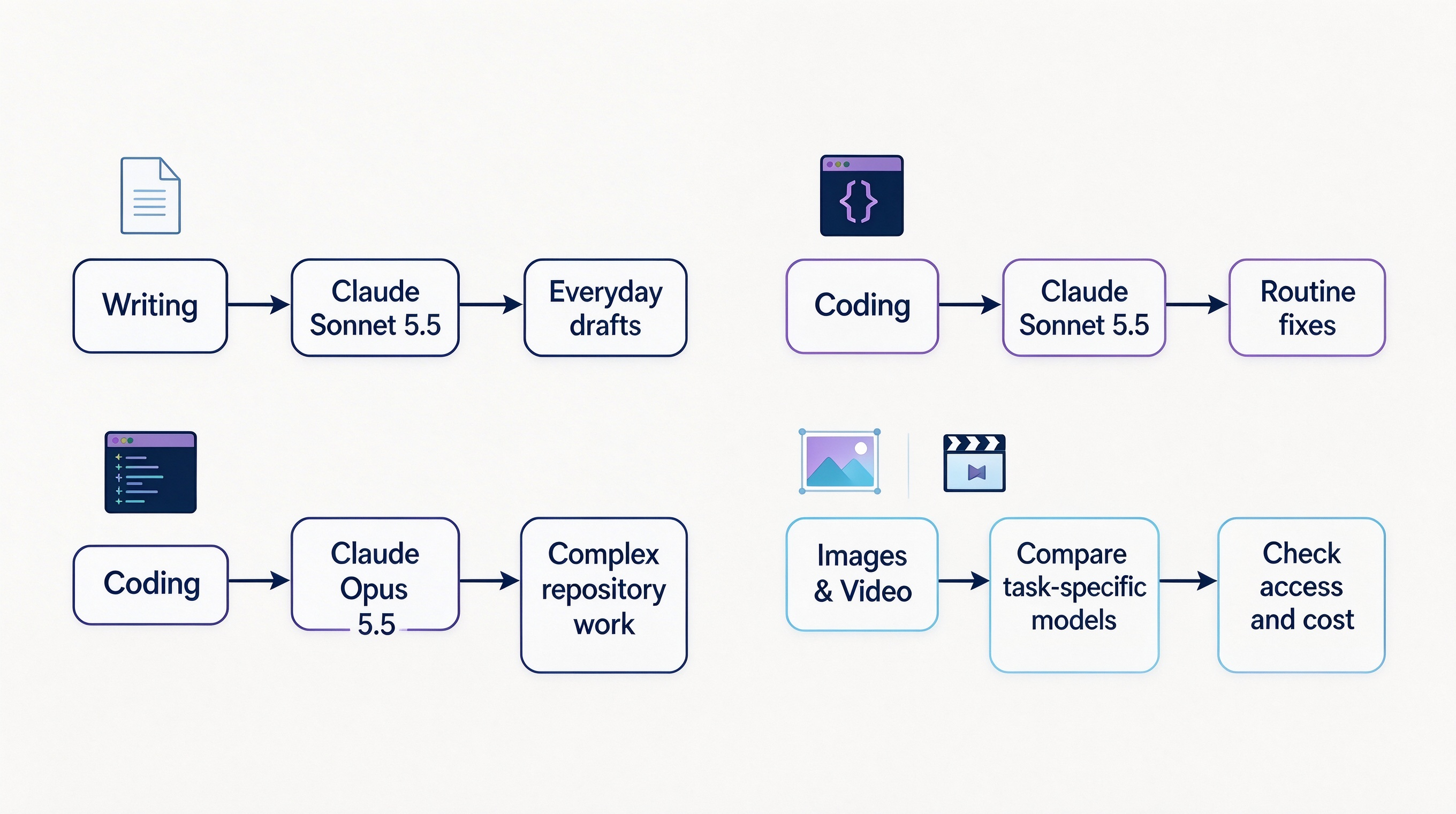
A visual guide to the editorial recommendations above. These choices reflect task scope, access and cost; they are not universal benchmark winners.
02Best AI for writing: Sonnet first, Opus for complex work
Our practical writing pick is Claude Sonnet 5.5 for routine emails, drafts and document work. Anthropic describes Sonnet as suited to well-scoped tasks and polished documents, while positioning Opus for more complex, open-ended work. That is a vendor description, not an independent writing comparison.
This choice puts a usable workflow ahead of a general text rank. Start through Claude. Its pricing page lists Sonnet access on the Free plan, with usage limits. It does not promise the leaderboard’s effort setting. For a short draft, try the accessible option before upgrading.
Consider Opus when a document needs several competing requirements resolved: preserving source facts, following a detailed brief and explaining uncertain conclusions. Keep Sonnet as the default for a bounded rewrite. Neither recommendation means the model can supply missing evidence; check citations and factual claims against your source material.
Gemini Argon is worth watching for broader text work: gemini-4-argon-high leads the saved Arena text list. However, the Google announcement describes a phased rollout. That page alone does not confirm ordinary users can select the ranked variant today. We therefore do not make it the default consumer writing pick.
The table below is overall text evidence, not a writing-only verdict. For a word-limited draft, the Word Counter checks length and Text Diff shows what changed. These tools help review the output; they do not validate its facts.
| Rank | Model | Rating | Reported score interval | Votes |
|---|---|---|---|---|
| 1 | gemini-4-argon-high | 1525.39564355718 | 1516.54802944404 – 1534.24325767032 | 4892 |
| 2 | claude-opus-5.5-high | 1507.07586874072 | 1498.96938553698 – 1515.18235194446 | 6272 |
| 3 | claude-opus-4-6-high | 1504.3552097895 | 1500.97462059483 – 1507.73579898417 | 79415 |
| 4 | claude-fable-5-high | 1503.69357717281 | 1499.35333396953 – 1508.0338203761 | 40026 |
| 5 | claude-opus-4-7-high | 1501.02589669737 | 1497.26539023928 – 1504.78640315546 | 65192 |
| 6 | claude-fable-5.1-max | 1500.72902915649 | 1494.49121530066 – 1506.96684301231 | 13063 |
| 7 | claude-opus-4-6 | 1497.7335923253 | 1494.44044676606 – 1501.02673788453 | 84095 |
| 8 | gemini-3.8-flash-high | 1496.50395488149 | 1491.75666396365 – 1501.25124579933 | 31437 |
| 9 | muse-spark-1.3-max | 1494.1854645692 | 1488.29782725767 – 1500.07310188073 | 14694 |
| 10 | claude-opus-4-7 | 1493.97342718161 | 1490.21223367817 – 1497.73462068505 | 66315 |
03Best AI for coding: Opus for depth, Sonnet for routine fixes
Our starting pick for difficult repository work is Claude Opus 5.5. Its Max variant leads the saved Arena agentic coding list. The next two entries are GPT 6 Sol and GPT 6.1 Sol at Max effort. Their reported score intervals overlap with Opus, so the saved order does not establish a decisive win.
The useful split is task scope. Anthropic’s Sonnet comparison distinguishes well-scoped bug fixing from complex work requiring sustained judgment. Use Sonnet first for a known error with a clear acceptance test. Consider Opus for a migration or investigation spanning several files, where deciding what to change is part of the job.
API cost makes that split concrete: Sonnet is listed at $2 per million input tokens and $10 per million output tokens; Opus is $4 and $20 respectively. These are API token rates, not monthly subscription prices. A lower rate does not guarantee a cheaper completed task if the model needs more attempts.
For an agent workflow, start with Claude Code. The plan comparison includes Claude Code in Pro and Max, but not Free. If you already use a GPT-based agent, compare its working patch with Claude before adding another subscription. The acceptance condition should be a passing test and a reviewable diff, not a fluent explanation.
| Rank | Model | Net improvement | Reported score interval | Votes |
|---|---|---|---|---|
| 1 | Claude Opus 5.5 (Max) | 0.175791304123044 | 0.116658659143248 – 0.23492394910284 | 1721 |
| 2 | GPT 6 Sol (Max) | 0.155938111393545 | 0.111939689246083 – 0.199936533541007 | 2048 |
| 3 | GPT 6.1 Sol (Max) | 0.155745638484795 | 0.122422486371293 – 0.189068790598296 | 3733 |
| 4 | Claude Sonnet 5.5 (Max) | 0.13452404298606 | 0.086488175120727 – 0.182559910851392 | 2225 |
| 5 | GPT 6 Astra (Max) | 0.133547410417276 | 0.0950198440948437 – 0.172074976739708 | 3949 |
| 6 | Claude Fable 5.1 (Max) | 0.115028776464626 | 0.0823098892161218 – 0.14774766371313 | 4749 |
| 7 | Gemini 4 Argon (High) | 0.104751179342118 | 0.0775206868226524 – 0.131981671861583 | 7922 |
| 8 | Claude Fable 5 (High) | 0.100576427778229 | 0.0799979365384433 – 0.121154919018014 | 12196 |
| 9 | GPT 5.6 Sol (xHigh) | 0.0844330067257838 | 0.0639704317668014 – 0.104895581684766 | 10595 |
| 10 | Claude Opus 5 (Max) | 0.0756466464627702 | 0.0535100156150235 – 0.0977832773105169 | 6882 |
04Best AI for building websites: choose the workflow, then the model
For a bounded landing page or UI change, start with Sonnet; for a more complex implementation, consider Opus. Our saved Arena WebDev list places claude-opus-5.5-max first, gpt-6-astra-max second and claude-sonnet-5.5-xhigh third. This supports a website shortlist, not a promise that any output is ready to deploy.
The distinction from general coding matters: a page must look right and behave correctly. Use a brief that includes the actual copy, mobile layout, form states and keyboard access. Keep the faster or less costly option when it meets that brief; escalate only when the remaining problem needs deeper reasoning. Inspect the rendered page and its code before launch.
| Rank | Model | Rating | Reported score interval | Votes |
|---|---|---|---|---|
| 1 | claude-opus-5.5-max | 1813.02814972833 | 1797.68783479883 – 1828.36846465782 | 2294 |
| 2 | gpt-6-astra-max | 1786.11411164474 | 1775.15083363138 – 1797.0773896581 | 5189 |
| 3 | claude-sonnet-5.5-xhigh | 1774.28553618681 | 1759.32719507453 – 1789.24387729909 | 2323 |
| 4 | gpt-6.1-sol-max | 1755.39826733264 | 1740.39478479774 – 1770.40174986754 | 2102 |
| 5 | claude-fable-5.1-max | 1743.70938652654 | 1734.33815167157 – 1753.08062138151 | 6663 |
| 6 | claude-sonnet-5.5-high | 1714.8840737505 | 1703.91685994401 – 1725.851287557 | 3984 |
| 7 | claude-opus-5-max | 1691.31117062931 | 1684.92954037433 – 1697.69280088429 | 17320 |
| 8 | gpt-6-sol-max | 1688.1815937716 | 1676.49275741192 – 1699.87043013128 | 3407 |
| 9 | gemini-4-argon-high | 1677.80588955884 | 1662.41560033117 – 1693.1961787865 | 1771 |
| 10 | qwen3.8-max-0902 | 1673.50148037715 | 1665.98369118751 – 1681.01926956679 | 11182 |
05Best AI for images: shortlist GPT image, separate generation from editing
For creating an image from text, our first candidate is gpt-image-2.5-sunburst. In the saved Arena text-to-image list, it scores 1424.55 against Flare’s 1397.62. Their reported intervals do not overlap in this snapshot. That is stronger preference evidence than the close video ranking below, but it is not a measure of exact text accuracy or brand consistency.
Compare Sunburst with Flare if both are available in your chosen service. For an invitation or product graphic, prioritize correct names, dates, object counts and room for copy. For a series, prioritize consistent style. A photo retouching job needs editing-specific evidence; this text-to-image category does not answer it.
We have not confirmed these exact variants’ current product access, price or speed from accessible official documentation. Treat them as research candidates, not a purchase recommendation. Once you have a usable website asset, Image Compressor can prepare its file size without replacing the creative review.
Image examples: text accuracy and composition
The two user-supplied posters below illustrate what to inspect when choosing an image generator. The brief called for one white coffee cup, a small plant on the left, light from the right, and the exact text “MORNING COFFEE”, “OPEN DAILY” and “8 AM – 6 PM”. Model names, settings, generation dates, attempts, costs and any selection or editing history were not recorded. We have not confirmed identical prompts or settings. These examples are not a controlled model comparison and are not outputs attributed to the Arena candidates above.
Sample A
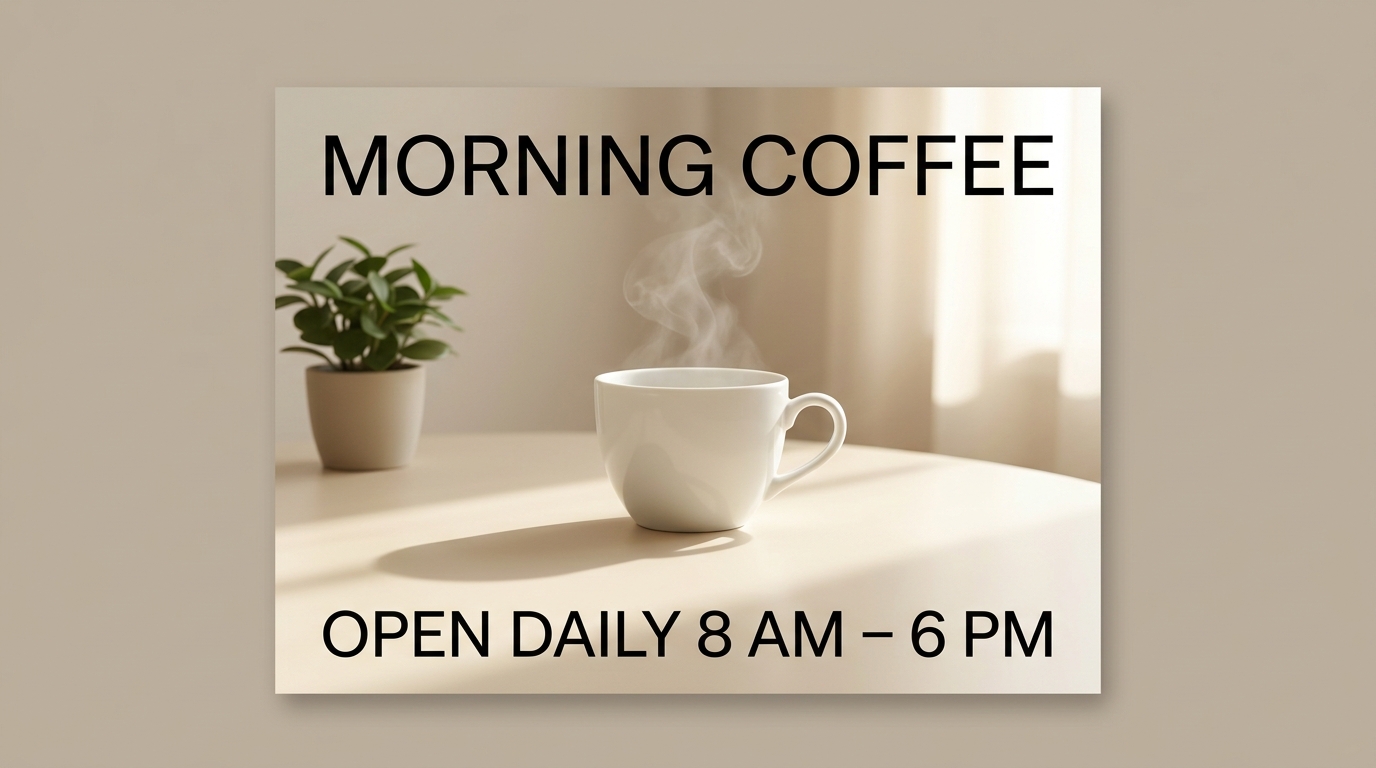
Sample A presents the scene inside a framed poster with a broad outer margin. All requested text is visible; “OPEN DAILY” and the hours share the bottom line. It shows one cup with steam, one plant on the left and light entering from the right.
Sample B

Sample B gives more space to the cup and headline, with “OPEN DAILY” and the hours on separate lines. All requested text is visible. The plant is larger and cropped at the left edge, while the cup and steam dominate the composition.
Both images preserve the requested wording and one-cup scene. Sample A emphasizes the framed poster; Sample B emphasizes the product. Neither demonstrates consistent performance across requests. For your own comparison, record the exact model and prompt, keep the settings comparable, and judge text accuracy and layout against your intended use.
| Rank | Model | Rating | Reported score interval | Votes |
|---|---|---|---|---|
| 1 | gpt-image-2.5-sunburst | 1424.55398863277 | 1417.72808698454 – 1431.37989028099 | 17752 |
| 2 | gpt-image-2.5-flare | 1397.62451299511 | 1390.86149812867 – 1404.38752786156 | 16889 |
| 3 | gpt-image-2 (medium) | 1383.03740002627 | 1378.95476541372 – 1387.12003463883 | 93334 |
| 4 | grok-imagine-image-2.0 (canvas) | 1333.54256154707 | 1321.98306670981 – 1345.10205638433 | 3113 |
| 5 | mai-image-2.6 | 1332.10167065228 | 1326.68575630878 – 1337.51758499579 | 25091 |
| 6 | gemini-nano-banana-2.1 | 1327.78390112008 | 1319.02097048696 – 1336.5468317532 | 5310 |
| 7 | reve-2.1 | 1301.71005590931 | 1294.19778507321 – 1309.22232674542 | 8249 |
| 8 | grok-imagine-image-2.0 (20260801) | 1294.21469572104 | 1287.85210862203 – 1300.57728282005 | 14483 |
| 9 | muse-image | 1274.03589871156 | 1268.93587160759 – 1279.13592581554 | 42262 |
| 10 | reve-2.0 | 1269.199443628 | 1263.01727945905 – 1275.38160779695 | 15773 |
06Best AI for video: the top rank is too close to decide
Our saved Arena text-to-video list puts gemini-omni-1.1-flash at 1516.21 and gemini-omni-flash at 1512.89. The reported intervals overlap. The first has 1,784 votes and the second 26,576; the larger vote count is context, not proof that the second is better.
Our recommendation is to compare these two candidates rather than declare a video champion. Start by deciding whether you need a new scene from text, animation of an existing image or editing of existing footage. The evidence here covers the first task. It does not establish support for the others, clip duration, audio features or current plan access.
For a short generated scene, judge whether the subject stays consistent, the action completes and the camera movement makes sense. Count the attempts needed for a usable clip. The candidate that meets your brief within your budget is more useful than a marginally higher preference score.
| Rank | Model | Rating | Reported score interval | Votes |
|---|---|---|---|---|
| 1 | gemini-omni-1.1-flash | 1516.21189213155 | 1500.77326303854 – 1531.65052122457 | 1784 |
| 2 | gemini-omni-flash | 1512.88682891385 | 1503.93242865513 – 1521.84122917256 | 26576 |
| 3 | flux-3-video | 1493.05433328478 | 1475.83401705789 – 1510.27464951168 | 1302 |
| 4 | grok-imagine-video-1.5-agent | 1492.30467043463 | 1474.00517647935 – 1510.60416438991 | 1218 |
| 5 | dreamina-seedance-2.0-720p | 1479.17570500764 | 1471.16007764279 – 1487.1913323725 | 56318 |
| 6 | wan3.0 | 1476.27399343671 | 1463.61748036407 – 1488.93050650935 | 2598 |
| 7 | dreamina-seedance-2.5-720p | 1473.93179800317 | 1465.38800789009 – 1482.47558811624 | 8001 |
| 8 | minimax-h3 | 1460.34325795131 | 1451.73760040673 – 1468.94891549588 | 11417 |
| 9 | muse-video | 1455.82040191904 | 1441.15884977695 – 1470.48195406114 | 2188 |
| 10 | happyhorse-1.0 | 1427.18252779929 | 1414.66670875934 – 1439.69834683923 | 22264 |
07Best AI on a budget: free chat, subscription or API?
For everyday text work, our verified no-payment starting route is Claude Free, which lists Sonnet and Haiku access. This is a practical option, not a claim that Claude beats every free service. Free does not include Opus or Claude Code in the plan comparison, and usage limits apply.
Claude Pro is listed at $20 when billed monthly, or $200 paid upfront for a year, before applicable tax. Use the monthly figure when comparing a monthly budget; the advertised annual monthly equivalent requires an upfront commitment. Verify the current plan page before buying.
| Route | Choose it when | Cost basis |
|---|---|---|
| Free chat | You need occasional writing help and can work within limits. | No subscription payment; confirm the model and limits. |
| Pro subscription | You need the listed paid models or Claude Code. | Monthly or annual plan charge, with usage limits. |
| API | You are building a repeatable workflow and can measure usage. | Input and output tokens, plus any applicable caching or other charges. |
For an API example, 100,000 input tokens plus 20,000 output tokens costs $0.40 with the listed Sonnet rates, versus $0.80 with Opus. This calculation excludes caching and other charges and assumes identical token usage. It is a comparison of rates, not a forecast of your task cost. For a different workflow, see how to run an LLM locally.
08How we chose these recommendations
We used category-specific Arena results captured on October 13, 2026 at 14:22 UTC, then checked official model and plan pages on October 14. Each display shows the top ten entries, while the recommendations above focus on the most relevant choices. Arena’s methodology explains its preference-based evaluations; the agent category uses a different scoring basis. Scores across categories are not comparable.
The capture date is when we saved the data, not a universal last-updated date for every source. The original text and agent lists had already changed when checked the next day. Use the linked source for current order. We have not independently tested every model, and vendor capability claims remain attributed to their vendors. Writing and budget picks weigh access and cost rather than simply copying the top rank.
09Sources
- Anthropic: Claude Sonnet 5.5 — https://www.anthropic.com/claude-sonnet-5-5 (accessed October 14, 2026).
- Claude app — https://claude.ai/ (accessed October 14, 2026).
- Claude plans and pricing — https://claude.com/pricing (accessed October 14, 2026).
- Arena Text leaderboard — https://arena.ai/leaderboard/chat/text (accessed October 14, 2026).
- Google: Introducing Gemini 4 Argon — https://blog.google/innovation-and-ai/models-and-research/gemini-models/gemini-4-argon/ (accessed October 14, 2026).
- Arena Agent Code leaderboard — https://arena.ai/leaderboard/agent/code (accessed October 14, 2026).
- Anthropic: Claude Opus 5.5 — https://www.anthropic.com/claude-opus-5-5 (accessed October 14, 2026).
- Claude Code — https://claude.com/product/claude-code (accessed October 14, 2026).
- Arena WebDev leaderboard — https://arena.ai/leaderboard/code/webdev (accessed October 14, 2026).
- Arena Text-to-Image leaderboard — https://arena.ai/leaderboard/image/text-to-image (accessed October 14, 2026).
- Arena Text-to-Video leaderboard — https://arena.ai/leaderboard/video/text-to-video (accessed October 14, 2026).
- How Arena works — https://arena.ai/how-it-works (accessed October 14, 2026).
Frequently asked questions
What is the best AI model in 2026?
For routine writing, our practical pick is Claude Sonnet 5.5. For complex repository work, consider Claude Opus 5.5. Images and video need their own category comparisons. These are editorial recommendations based on a dated Arena snapshot and official pages, not an independent hands-on test.
Which AI is best for coding?
Start with Sonnet 5.5 for a well-scoped fix and consider Opus 5.5 for complex work. Opus leads our saved agentic coding list, but its score interval overlaps with the leading GPT Sol variants. Compare a passing test, patch scope and completed-task cost.
Which AI model is best for writing?
Sonnet 5.5 is our practical starting pick for everyday drafts and document work. Consider Opus for complex briefs. Overall text rankings are not writing-only tests; review whether the output preserves your facts and meets your tone and length requirements.
What is the best free AI model?
Claude Free is our verified starting route for occasional text work, with Sonnet and Haiku listed on its plan page. It has usage limits and does not include Opus or Claude Code. We have not compared every free service, so this is not a universal free-model winner.
How do I compare AI models?
Choose one real task and define success first. Give two accessible candidates the same input, then compare correctness, manual edits, retries and cost. Confirm the exact model or variant is included in the app or API you plan to use.
How often do AI model rankings change?
This guide uses a snapshot captured on October 13, 2026. The original text and agent lists had changed when checked the next day. Recheck the linked leaderboard when deciding; a saved position is not a current availability or performance guarantee.